
How to train for terrain based objectives while living in the flatlands.

I’m back with a slightly more specific “coaches corner” type of post to hopefully provide some helpful insight into some training protocols that can be useful for some. Long read, fair warning.
My quick background for anyone who I haven’t interacted with: My names Kyle Long and I’ve worked full time as a run coach and sports performance specialist for 20 years (very slow ultra runner myself, love of the game type of guy 😂). I come from a more traditional strength training background in terms of my education, and work primarily with “sub-elite” runners looking to chase big objectives, not have it kill them and have the training generally fit life. I mention that because a professional runner/top end elite is going to have different training requirements than what I typically outline in my posts here and I think it’s always important to say that out loud.
Something that comes up often in conversations I have with athletes is “how do you train for a vertically demanding race/objective if you live somewhere without much uphill available?”. While there’s no 1:1 replacement for being able to train on good uphill/downhill terrain in the build up to a demanding race or objective, there is plenty you can do to at least put yourself in a position to get your ass kicked a little less.
Generally when looking at how to prepare someone stuck in the flatlands who has eyes on something with some beefy uphill, there’s two primary concepts I try to instill in people at the start:
Accept your situation: There is just a reality that the version of you living in Florida is going to most likely perform a little rougher than the version of you living in Colorado when racing in the mountains. That doesn’t mean you’re stuck with “bad performances” if you live far from terrain, but it’s an important concept to not compare yourself to those who can get 4k or gain out their front door every day because it’ll just drive you crazy. That being said, while we can’t completely replace training in terrain, we can do a lot of work to get you closer.
Accept it’ll be a grind: Training for terrain based objectives in the flats isn’t sexy, it’s not very exciting and it’s not the most fun. That sounds kinda of obvious, but it’s an expectation I think is valuable to set with yourself before you take on a project. “Do the work so you can do the job” is a good headspace to have…you’re going to be doing hard, tedious work for a while, but it’s so you can go do something epic (the job) down the road.
From there, I look at the training itself. I ask:
-What tools DOES the athlete have access to? This can mean short bits of uphill, gym access, ability to travel a few hours at selected times to access terrain etc.
-What are the specific demands of the race/outing? How much ascent and descent are we looking at? What do the biggest/most challenging climbs and descents like? How technical is the terrain?
-Finally can we simulate the above demands using the above tools? And if not 1:1, how close can we get?
While there’s no one size fits all answer to “what’s best” in this situation, there are some general concepts and ideas we can put into action to generally have you in a better position for success on terrain. While repeating that there’s never a 1:1 replacement for truly training on up/down, we can:
Prepare with the strength work. This primarily focuses on 2 fronts: ascending strength and descending durability. These are two things you can build, to a degree, in the gym.
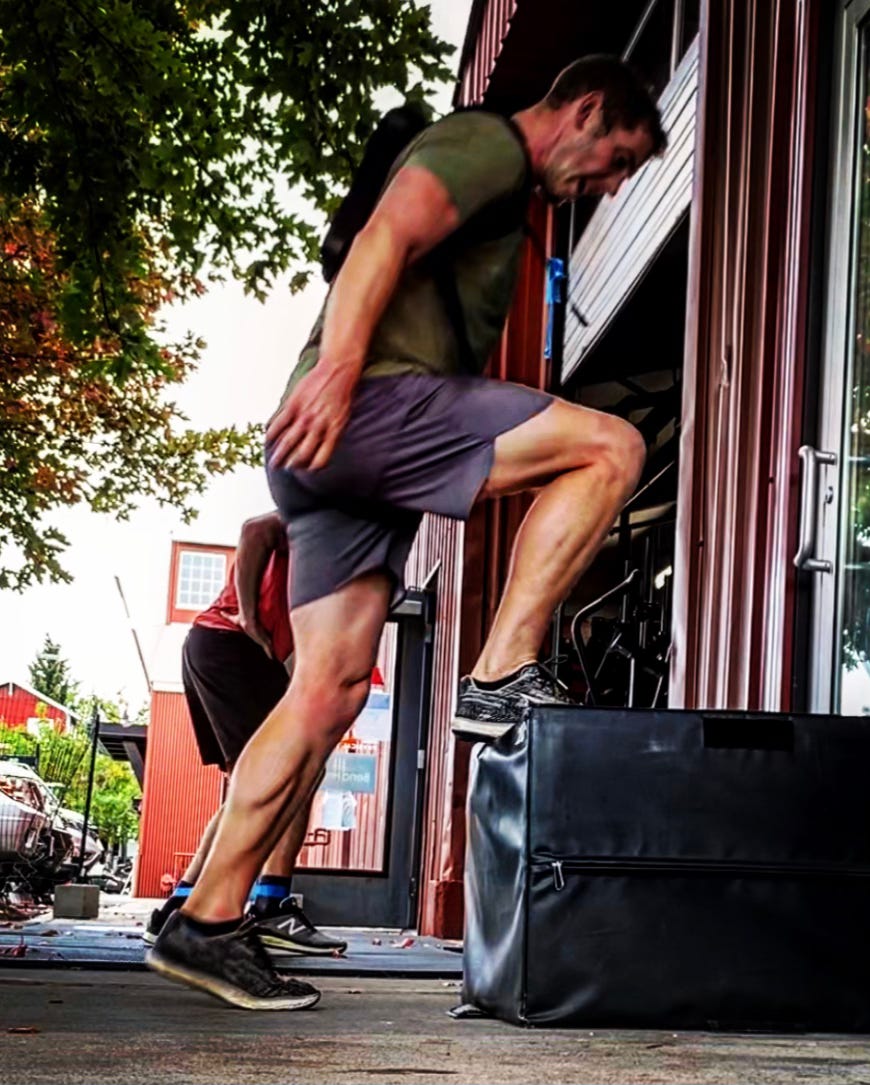
For the up, think stepping patterns in a variety of domains and modalities. Step ups are the most obvious, but sled work (push and drag), lunge patterns, step down patterns and unilateral hinging are all tools you can use to build your uphill ability. Touch various volumes. During some blocks go high volume, low load and then strategically work the inverse during other parts of your build, with low volume, high load. Build in progression to your strength work and play the long game.
For descending, think eccentrics, isometrics and landing phase focused plyometrics. Downhill running is essentially a repeated set of deceleration patterns, so training the eccentric (lengthening portion), isometric (static holds) and landing phase plyos (emphasis on deceleration on the landing) will go a long way in building some durability in the downhill when you can’t train on downhill terrain. Because I get asked a lot, below are some examples of each of those movements. There’s dozens more with tons of variations, but these will hopefully at least give you an idea of what I’m speaking to:
-Eccentrics: split squat positions with a slow descent, RDL variations with slow descents, Patrick step down variations with slow descents etc.
-Isometrics: split squat holds, wall sits, calf raise holds etc.
-Plyometrics: drop lunges, depth drops, broad jumps etc
When worked properly into a program, these should 1) not negatively impact run performance and 2) build some downhill durability and uphill capacity.
Second, we look at “what DO you have?” access to?
For some, this might mean a lone 100ft hill, for others, it might be a stairclimber, local high school stadium stairs, hell I’ve had guys train in 8 story parking garages. Theres almost always SOME option, to do SOMETHING. Sure, repeats up a 100ft hill won’t hit the same way as a 1,500ft sustained climb, but if you can spend some time each week doing progressively more up/down efforts on any gradual grade, it’ll net you surprising amounts of durability and familiarity with moving up and down on bigger terrain. Using myself as an example: I spent about a month in a big city with literally zero uphill of any substance except for a singular, 125 foot hill. Straight up, straight down from a river bed with one little foot path up. It was spring time and I was prepping for a move into the Canadian Rockies and so for kicks and giggles one week, I did a 10,000ft week on that stupid hill. Didn’t track mileage, spent each day on the hill and while it was less than exciting, it was still 10k of up, 10k of down, broken down into a 60-90 minute session over the course of the week. Was it the same as doing a few big days in the mountains? No. Was it better than nothing? Yes. Just a one off example of making the best of what you’re given.
-Uphill Treadmill work/stairclimbers: the obvious focus here is ascending, but there’s a few ways I’ve seen success with athletes in terms of how to utilize them.
+The first is what you’d expect: long, progressive climbing sessions built intelligently into training blocks. Both power hiking sessions and lower grade run sessions on the treadmill will have value so utilize both.
+The second is to stack either the stairs or uphill power hike sessions with flat mileage to simulate the transition between uphill legs and run legs. An example of this could look something like: 4x10 minute climb at 10% grade+2 mile run. It’s simple, but taps into a little different stimulus than just hiking uphill endlessly and translates to a race environment half way decently.
Wrapping up with a few more broader scope things:
-Being intentional about your peak efforts, B2B efforts and important long runs is even more important for those stuck with limited terrain. Often, someone has access to some better vert a few hours away, but obviously that isn’t sustainable to go touch every week for most folks with family/work responsibilities. BUT, if you can look at a 12/16/20 week training build, identify a few days you can get away and make the most of them, it really pays off huge. The difference I see in race day performance when someone can combine smart training with a few intentional big days out on terrain they have to drive to vs those who just do the training smart is massive. Hire the babysitter, the dog sitter, whatever it takes if possible to get away for a big few sessions and you’ll be set up for success FAR more on race day because of it.
-Rucking. This is another long arc tool and something that can be generally useful for most distance athletes, but spending some casual miles (hiking/walking) under load each week has been proven to me time and time again as a useful thing. It’s not going to net you as significant gains as some of the other previously mentioned items, but I’ve seen a pretty marked difference in folks who get out 1-3x a week, even just on a 30 minute dog walk here and there with a pack, vest or plane carrier to spend some time under load. Obviously we get some nice stress on the legs here but you’re also getting some structural strength built around your ability to carry load (so a heavy race pack is less consequential) and generally it will help reinforce an upright posture under fatigue that can be helpful. Don’t run with it, don’t try and go ruck 20 miles with it, just spend 30-60 minutes out a time or two a week if you can for some chill movement and it’ll do you some good.
-Hammer in the accessory strength work. Spend time each week on the feet, ankles, knees and hips in any way you can. Get some mini bands, a balance board (love my mobo board, no affiliation, just genuinely enjoy it) and a foam pad and spend a little time making sure that all the little areas you may typically strengthen running in the mountains on the regular, get some love and attention.
Circling back at the end here, this is just all an accumulation of information gained over my last 20 years of coaching. Some of this may be helpful to some, all of it may be unhelpful to others and these are just some examples of what I have seen work well. But my hope whenever I throw out chunks of things I’ve learned working with people is that it can help even a few individuals here refine their training and chase the things they want a little bit better. There are other paths, other methods and ideas, concepts and training routes to go if your feet are stuck in the flats but your eyes are on the alpine, these are just ones I can speak to myself.
If you want to talk shop and learn more about how I program for mountain athletes and those chasing big, long objectives, drop me a note on my contact form HERE and we can set up a consult call.
Onward (and upward), always!