

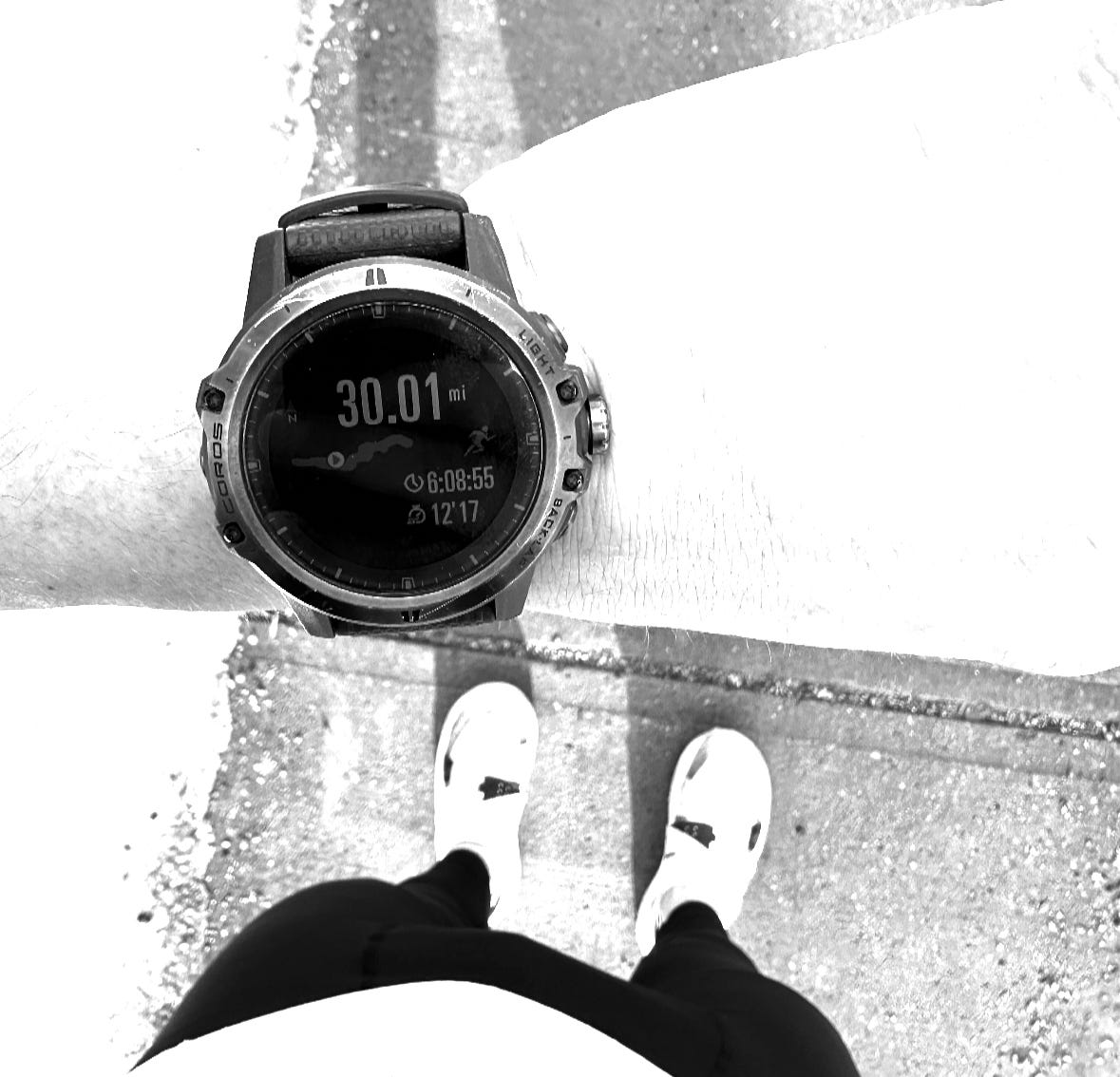
*I preface this piece with the caveat of: I work typically with sub elite endurance athletes. I do not coach professional runners or elite level athletes. Metrics matter, more so to these individuals. This piece is focused on what the larger majority of athletes in the ultra space are: people with real lives, work, family and more that are trying to balance chasing big objectives in good style with the needs and demands of life.
20 years of coaching and thousands of athletes later, if someone asked me “What is the single factor you’d attribute most to an athlete being successful or unsuccessful in the ultra space?” my answer would be easy:
Those who approach training with a relaxed, fluid headspace will always succeed more than those who are a prisoner to their performance metrics. Those who train by feel and measure joy first, never perform worse than those who are glued to a watch, fueled by what HR zone they’re in or what their current threshold pace looks like.
Professional athletes are outliers. Their demands do not apply to someone who is balancing work, family and all the other life variables most of us do with training. That is not to say that the “every day athlete” cannot pursue performance and chase lofty goals in the endurance space. You can take your training seriously, you can take your racing/exploring seriously and you can invest a lot of time and effort into the training for your objectives, while still generally enjoying them, not being a slave to numbers and also not have training become a second full time job.
Across the thousands of athletes I have coached, I can say with certainty that those who do 85% of the work programmed perform at the same level OR BETTER than those who neurotically check off every single set, rep and mile during the week and constantly report 100% compliance in their training.
Why?
Because life is going to happen. Work is going to run late, a kid is going to get sick, the weather is going to suck, and those who approach training with a relaxed headspace, who can be fluid and flexible and not lose sleep over a shortened workout or adjusted run schedule for the week, will navigate their way through large training blocks carrying immensely less stress than those who will put all of life on hold to get in every single workout to the rep and step. The amount you will gain/lose in the last 10-15% of training, is pretty negligible for most of us. The margins are tighter on a professional athlete who is already functioning at 99% of their optimization potential. In that space, a missed few sessions or an altered plan has far more serious repercussions…but for John Doe who is just trying to bring down his 8hr 50k PR and have his next race not kick his ass so much, he can exhale and not worry too much about performance if he misses a workout here or there or gets sick for a week or goes on vacation and runs a little less than he was supposed to.
All of this to say, simply, relax. You can do incredible things at a high level and not exist in a state of panic over your training. At the end of the day, we GET to do these things. They should bring you joy and not feel like a job. I write this in hopes of not having you completely ignore your metrics, they DO have some value, but more so to free you from the constraints of them. They do not define you, they are not ALL that matters ad for most, not even in the top few things that matter.
Did today feel good?
Did today bring me joy?
Did today make me feel capable?
Did today make me desire more?
Those are, for almost all of us, what matters. Chase them and you will succeed.
Onward, Always.
Yeah, an important message, thank you Kyle. I was reflecting recently on how a "perfect" training block full of green metrics doesn't guarantee a good race day anyway. There is only so much we can control. Learning to relax and be flexible seems much better for long-term longevity than constantly stressing over the daily data.