

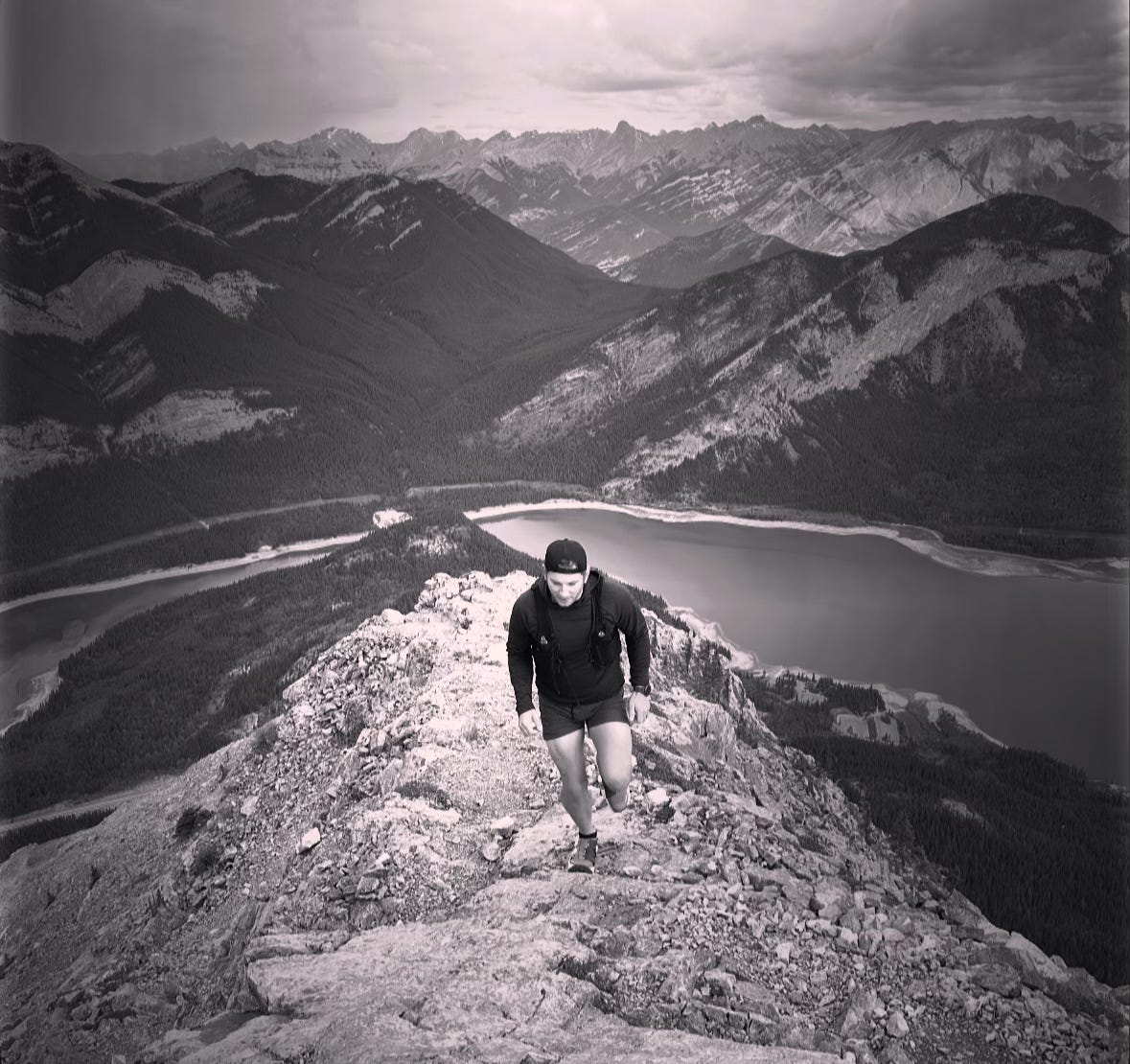
If you’ve spent time in the mountains, you’ve more than likely been humbled by the climbs and descents. Gravity is real and the terrain doesn’t care and the uphill will crush you while the never ending descents finishes you off. But there is hope.
Vert is something that can be prepared for, both in gaining and losing it. It’s a skill AND an ability. And like any skill, it can be trained — not just through moving uphill in training, but by prescribing strength work that mimics what the body actually experiences on steep terrain.
In the gym (or your garage or living room), we can reverse-engineer uphill and downhill movement into smart, focused strength sessions. Through isometrics, eccentrics, and stepping patterns, you
can become a stronger, more resilient mountain athlete — even if you don’t live at elevation or near terrain.
We don’t need fancy equipment. We need intention, progression, and consistency. This manual gives you the blueprint.
How it breaks you…and how to get ahead of it.
The up: Climbing is all about repeated force production. You’re pulling yourself up the mountain with your glutes, quads, and calves over and over again. That’s high-rep, low-rest output. The fatigue is local — legs go before lungs.
The down: Descending is where most runners get wrecked. It’s not the lungs — it’s the eccentric load and repetitive pounding on the ankles, knees and hips. Every step downhill is a controlled fall. Your quads, hips, and trunk act as brakes. Done enough, it’s a recipe for a bad time
So, we train both ends.
Isometrics teach your tissues to hold tension — important for steep climbs and loaded descents.
Eccentrics build braking strength, control, and durability — big for downhills and reducing injury risk all around.
Stepping patterns mimic the mechanical pattern of climbing — simple & effective.
You scale and build vert into your training plan much as you’d add mileage over the weeks to prep for a race or objective. It should be progressive while also reflecting the specific needs of your training goal. Vertical gain is a stressor — it needs to be tracked and managed like mileage volume. Some weeks you build, some weeks you pull back. Just as endless miles will only get you so far, so will endless vert. Intention and direction matter.
4 week sample strength protocol:
This is a minimalist plan built to prep mountain athletes specifically for steeper terrain. Do it 2x/week. Add it into your run schedule just like any other session — not as an afterthought. Rest 30–60 seconds between sets unless otherwise noted. Cycle through each session 3 times per workout.
WEEK 1-2 (Focus: Isometrics + Patterning)
Wall Sit Hold (loaded or unloaded) – 3 x 30-45 sec
Isometric Split Squat w/ KB pass – 3 x 20 sec/leg (bottom position)
RE Split squat – 3 x 12/leg (slow, controlled)
Walking calf raise – 3 x 10/leg (3-second lowering)
Plank – 3 x 30 sec
WEEK 3-4 (Focus: Eccentrics + Load)
Sumo Goblet Squat w/ 3-Second Eccentric – 3 x 8
Step Down Off Box – 3 x 8/leg (3-sec lower, light DB optional)
Eccentric lunges – 3 x 8/leg (hold dumbbells) with a 3s hold at the bottom of each rep
Bent knee calf raise – 3 x 12 (2-second pause at top)
Side Plank with hip lift – 2 x 8/side
Progress the reps or the load each week — but don’t rush it. The point is controlled force and time under tension, not racing through the circuit. After 4-6 weeks of building, you’ll want to consider substituting movement patterns to introduce some new stimuli.
This kind of work won’t show up on your Strava the same way a long run will. But it will show up when you’re 6 hours into a mountain ultra and your legs still work. It’ll show up when you descend 3,000ft of technical terrain and still have control. It’s quiet work — but it’s the kind that gets you to a finish line or a summit in one piece.
Train vertical like it matters. Because it does.
Onward, Always.
Great starting protocol!